Wednesday, July 6, 2011

CALIFORNIA BUDGET (FY 2011/12) SIGNED BEFORE DEADLINE

On Thursday, June 30, Governor Jerry Brown signed the main budget bill (SB 87) and about half of the related "trailer" bills, marking a rare on-time budget one day before the start of California's 2011/12 fiscal year. The signed budget includes cuts to public universities, reductions to the courts and closures of 70 parks, among other measures. Fortunately, for early childhood education, the budget includes the restoration of $200 million in child care funding that was initially passed by the Legislature on June 15. Below is a detailed description of the child care funding restorations in the approved state budget:


Child Care Funding Restorations included in the Approved 2011/12 Budget
  • Restores 10% Standard Reimbursement Rate cut to the Title V contracts
  • Rescinds the proposed 10% family fee increase
  • Reinstates child care services for 11- and 12-year old children
  • Reduces across the board contract reduction from 15% to 11% (in Education trailer bill - AB 114) Establishes the Early Learning Advisory Council (ELAC) into statute – ensuring its long-term presence
However, the 2011/12 budget does include the following changes and cuts to child care funding:

 
Child Care Funding Cuts included in the Approved 2011/12 Budget

 
CalWORKs:
  • Limits families to 48 months of cash assistance (down from 60 months)
  • Cuts the CalWORKs grant amount by 8%
  • Reduces Earned Income Disregard (income not counted in determining monthly grant amount)
  • Extends Short-Term Reforms (allocations effective since 2009/10)
  • Suspends the Cal-Learn Program
Child Care and Development:
  • Reduces the State Median Income (SMI) from 75% to 70%
  • Reduces the licensed exempt provider rate from 80% to 60%
  • Reduces the amount of funding focused on quality initiatives (including the Centralized Eligibility List, the License Exempt Project and the Child Care Initiative Project) 
The budget signed by the governor is balanced and it is based upon a relatively even mix of cuts and tax revenues, as well as a smaller amount of funding shifts and internal borrowing. But, there could likely be a future challenge during this fiscal year. This approved budget includes $4 billion in revenues projection; however, if these revenues do not materialize by December 15, a trailer bill AB 121 (budget trigger provisions) will generate additional cuts in education, corrections and safety-net programs, which would take effect January 1, 2012. For example, if revenues fall short by more than $1 billion, then there will be a $23 million loss in child care funding, resulting in a 4% across-the-board reduction.

 
Additionally, the 2011/12 Budget removes child care and development from the Proposition 98 funding formula, with the only exception being half-day state-funded preschool programs. As a result of this realignment, the State General Fund (non-98 portion) would support the rest of child care and development. For the 2011/12 budget, these programs are supported in the allocation to the California Department of Education (CDE). So, at least for now, CDE will continue to administer the child care subsidy programs. It is uncertain if in the future, child care might be administered by local (county) government oversight.

Wednesday, May 25, 2011

STAND FOR CHILDREN DAY – STATE CAPITOL

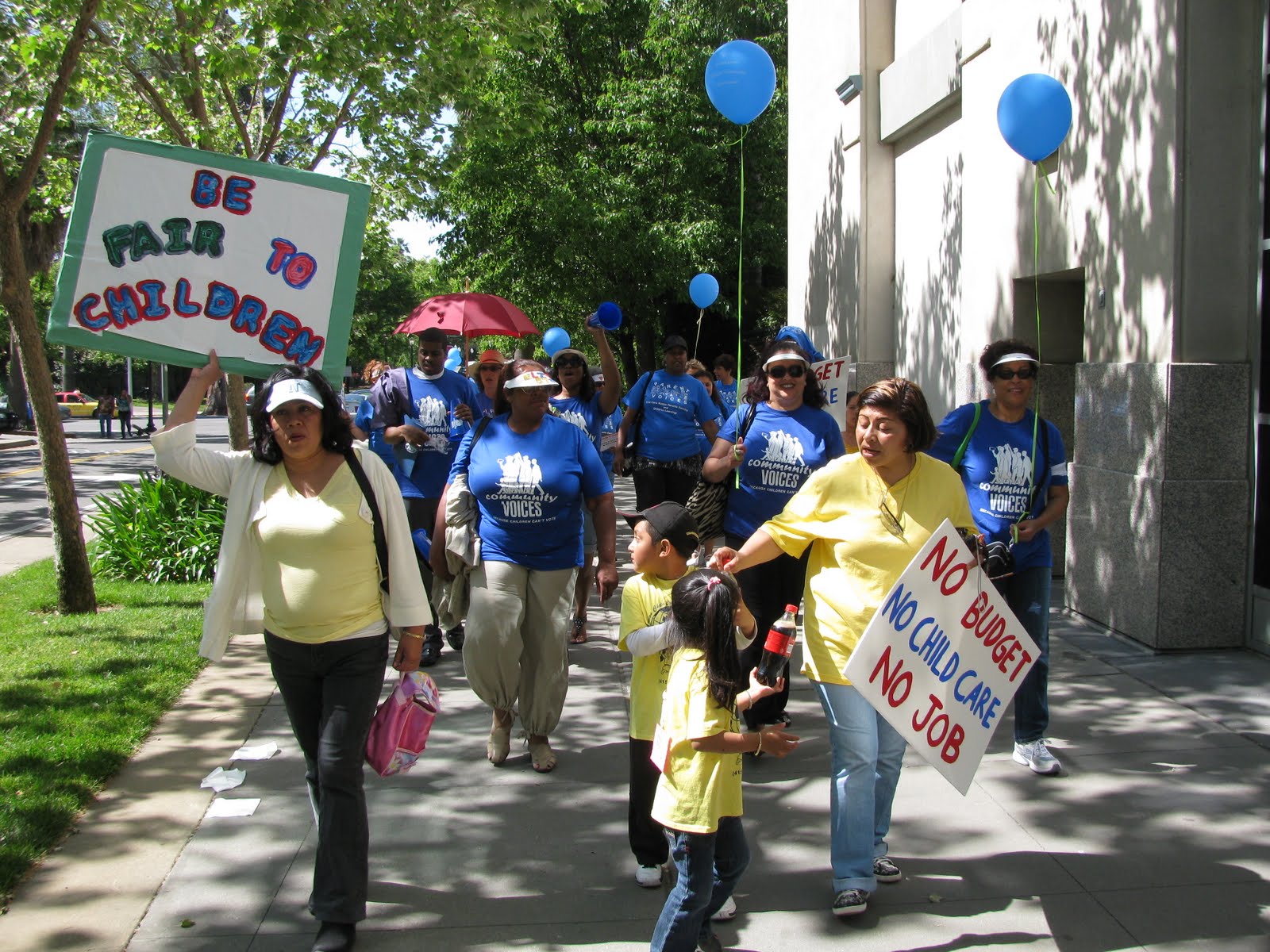
On May 4, a delegation of 70 parents and providers representing Community Voices went to Sacramento for the annual Stand for Children advocacy day, sponsored by Parent Voices. There were a total of 780 parents, providers and children at the Capitol that marched and rallied with the loud and unified message: “Child Care Keeps California Working!” The Community Voices delegation was made up of advocates representing Crystal Stairs, Inc., Mexican American Opportunity Foundation (MAOF), Center for Children and Family Services (CCFS), Options, Connections and Pathways, representing parents, providers and children from Los Angeles County.

Stand for Children is an annual event that brings together child care advocates from all around the state to the Capitol to advocate for child care. This year’s focus was protecting child care funding from further cuts and advocating for smart revenue solutions to close the budget shortfall. Delegations carried the message that the State of California cannot rely on cuts alone to balance the budget. In the current budget, $720 million in child care reductions were made, and $500 million was approved and signed into law this past March.

Community Voices was an integral part of these advocacy efforts by joining families and children on the march to the capitol and the rally that preceded it where parent speakers from Butte, Los Angeles, Fresno, Marin and San Francisco Counties joined Assemblyman Ammiano, Assemblywoman Bonilla, Assemblywoman Mitchell, Assemblyman Swanson and Senator Evans. Maria Salinas, a parent advocate and member of Community Voices at Crystal Stairs, spoke at the rally on behalf of the Los Angeles County delegation. Maria Salinas described the need for a budget with revenue solutions to prevent an all-cuts budget, reminding the group that “we need a sensible budget that protects from further harm to families and children.”

Child care advocates received support from several state legislators who spoke at the rally on the steps of the Capitol. The gathering was especially energized by encouraging words from Assemblywoman Holly Mitchell, Chair of the Assembly Budget Sub-Committee on Health and Human Services:

“I hope your wings are strong. I congratulate Parent Voices and Community Voices on all you have done up until now. You have shown passion and perseverance. Your advocacy has been critical in saving Stage 3 and preserving state investment in early care and education. Our efforts must now be redoubled to save access to child care and ultimately to ensure that a safe healthy childhood with access to early care and education is a right instead of a privilege in America.”

Following the rally, parents and providers made visits to legislators asking them to support the Governor’s revenue package, sharing how additional cuts to programs would negatively impact their constituents. Community Voices members visited the offices of both Democrats and Republicans, including Assemblyman Antony Portantino, Assemblyman Mike Eng, Assemblyman Charles Calderon, Assemblyman Ricardo Lara, Assemblywoman Holly Mitchell, Assemblyman Cameron Smyth, Assemblyman Paul Cook; Senator Bob Huff, Senator Carol Liu, Senator Ron Calderon, and Senator Ed Hernandez.

This was a very successful event. Following visits with the legislators, Community Voices members headed back to Los Angeles County. These parents and providers are even more energized to continue their advocacy efforts back at home. For more information about getting involved with local child care advocacy efforts, please contact: publicaffairs@crystalstairs.org.

Submitted by Fred Munoz and Nicole J. Jones, Crystal Stairs, Inc


Photos from the Stand for Children March and Rally


Community Voices Members Marching Through Sacramento

Making Our Way to the State Capitol

Community Voice Members Carrying Signs and Chanting Along March Route

1Child Care Advocates Line the Streets of Sacramento

Parents, Providers AND Children Are Making Their Voices Heard

Community Voices Members Rallying in Front of Capitol

Maria Salinas Speaking Out for LA County Parents

Community Voices Members at Rally

Community Voices Members Head Back to LA County


Tuesday, January 18, 2011

Big Victory for Thousands of Working Families and Small Businesses

January 14, 2011

Speaker Pérez: Child Care Effort Succeeds--

SACRAMENTO—Assembly Speaker John A. Pérez (D-Los Angeles) today announced that thanks to efforts by the Assembly, California’s local First 5 Commissions, and the Brown Administration, thousands of working parents in California will continue to receive the child care services that allow them to stay in their jobs and keep their families off welfare.

“With the stroke of his blue pencil last fall, former Governor Schwarzenegger forced thousands of working parents to face the choice of losing their jobs or letting their kids fend for themselves,” Pérez said. “Today, I am pleased to announce that we did not let that happen and that this program is in fact being restored and is included in Governor Brown’s budget. This is a big win for working parents and their children, and also for the thousands of small business child care providers who would have had to close their doors or lay off their employees.”

In December, Speaker Pérez introduced AB 1, the first bill introduced in the 2011-2012 session of the Assembly, to reverse Schwarzenegger’s veto and restore the Stage 3 Child Care services that enable parents to transition from welfare to work. Speaking from the Assembly floor today, Pérez announced AB 1 would now be used as a vehicle if one is necessary to allocate existing transition funding until the budget is enacted and the program officially restored.

“Not only did Governor Brown hear us and restore Stage 3 Child Care in his budget this week, his administration is also actively working with us to identify existing funding that can be used to transition until the budget is enacted,” Pérez said. “As we move forward, should it be determined that any interim funding we identify requires authorizing legislation, I will make AB 1 available for that purpose.”

More than $40 million in bridge funding – including $6 million from cuts Speaker Pérez made to the Assembly’s own budget and additional funding he sought from the county First 5 commissions – helped buy time until Stage 3 Child Care services could be restored. A judge’s stay of the elimination of the services also allowed time for Speaker Pérez and other advocates to successfully push for the program’s restoration.

“Of course, there are still difficult cuts proposed to all child care programs – and undoubtedly, the final budget will have to include some of the proposed reductions,” Pérez said. “But as painful as those cuts may be, they will still be far better than Governor Schwarzenegger’s wholesale elimination throwing 60,000 families out of the workforce or their children into harm’s way. This is a very positive sign we can work with this Governor to create jobs, put California’s fiscal house in order, and make sure every Californian can find opportunity and the chance to succeed.”
Timeline:

October 8, 2010—Governor Schwarzenegger blue-pencils Stage 3 Child Care funds eliminating services for 81,000 children in 60,000 families transitioning from welfare to work.

October 19, 2010— Assembly Speaker John A. Pérez pledges $6 million from part of his 15% cut to the Assembly operating budget and contacts state and county First 5 commissions asking for help in providing bridge funding until Stage 3 Child Care can be restored. Local commissions take action throughout the next several weeks.

October 29, 2010—Alameda County judge issues stay in implementation of the cuts and orders November hearing.

November 5, 2010—Speaker Pérez announces more than $40 Million in bridge funding pledged so far.

November 17, 2010—Judge approves settlement keeping child care services available through end of year.

Dec 6, 2010— Speaker Pérez introduces AB 1 to reverse the veto and restore Stage 3 Child Care.

January 10, 2011—Governor Brown includes Stage 3 Child Care funding in his 2011-2012 budget proposal.

January 14, 2011—Speaker Pérez announces victory for working families and providers. Moves AB 1 to become authorizing vehicle if necessary for interim funding identified by Assembly and Brown Administration.

FOR IMMEDIATE RELEASE CONTACT: Shannon Murphy (916) 319-2408

Monday, January 17, 2011

Recently Elected Governor Jerry Brown Unveils New Budget Proposal for 2011-2012

On January 10, 2011, Governor Jerry Brown unveiled his 2011 - 2012 budget proposal addressing a $25.4 billion projected shortfall for the remainder of the 2010-11 and the upcoming 2011-12 fiscal years. The Governor’s budget includes many significant ongoing program reductions, posing very difficult decisions for the Legislature. His proposals touch nearly every area of the state budget—often (as in Medi-Cal) with proposed reductions similar to ones suggested by the prior Governor and rejected by the Legislature. While the Governor’s revenue proposals result in a $2 billion increase in the Proposition 98 minimum funding guarantee for schools above its current-law level, his budget would result in a small programmatic funding decline for K-12 and more significant reductions for community colleges and child care programs.


Here are the cuts as it pertains to Child Care, for detailed information on the budget please visit http://www.ebudget.ca.gov/:

Child Care and Development Program (Proposition 98)

General Fund Solutions

Decreases direct child care services, except Preschool, by $716 million in 2011-12 through the following actions:


• Eliminates services for 11-and 12-year olds. Reduces by $34 million CalWORKs Stage 1 (administered by Department of Social Services, savings reflected in that section) related to the elimination of this program.


• Reduces eligibility to 60 percent of the State Median Income from 75 percent of the State Median Income.


• Reduces the level of subsidies across the board.


• Provides greater flexibility at the local level to administer the remaining child care funding in order to implement the across-the-board reductions. In this regard, subsidized families would pay the difference between the subsidy and regular day care provider charges as a co-payment directly to the provider in lieu of the state’s administrative agents (Alternative Payment agencies and Title 5 contractors) assessing and collecting current family fees.


General Fund Policy Adjustments


• Sets aside $52.6 million in 2010-11 from one-time Proposition 98 settle-up funding to continue services for Stage 3 families effective April 2011, at a service level consistent with the policy solutions proposed for 2011-12. These policy solutions affect age and income eligibility and reduce subsidy levels across the board for all direct service child care programs.

• Decreases by $34.2 million in 2011-12 to reflect lower Stage 2 caseload projections to conform with the 48-month time limit that replaces long-term reforms as discussed in the Health and Human Services section.

General Fund Adjustments
• Increases CalWORKs Stage 2 by $241.5 million in 2011-12 to reflect a $4.2 million caseload increase and restoration of one-time funds used to support services in 2010-11 ($201 million of Proposition 98 one-time savings and $36.3 million American Recovery and Reinvestment Act (ARRA). Total base workload costs for Stage 2 is $435.2 million.

• Increases CalWORKs Stage 3 by $256.2 million in 2011-12 that reflects a caseload reduction of $42.4 million, restoration of one-time funds used in 2010-11 totaling $42.4 million ($23.7 million of prior year federal funds and $18.9 million ARRA), and restoration of the $256 million partial-year veto. Total base workload cost for Stage 3 is $342.4 million.

• Increases by $83.1 million in 2011-12 to restore General Child Care, State Preschool, Migrant Child Care, and Allowance for Handicapped programs that were required to utilize excess contract reserves to meet costs in 2010-11.

Non-General Fund Adjustments
• Decreases the Child Care and Development Funds (CCDF) by $18.5 million in 2011-12 to reflect removal of one-time carryover funds available in 2010-11 ($24.4 million), an increase of $3.2 million in carryover funds reserved for expenditures that promote quality improvement, and $2.7 million in available base grant funds.

• Decreases the ARRA funds by $110.1 million in 2011-12 to reflect the one-time nature of the fund source used for child care program for two years.

• Increases by $58 million in 2010-11 from unanticipated prior year federal CCDF carryover funding in 2010-11 to reflect additional costs driven by a court order to extend the date for Stage 3 funding termination from November 1 to December 31, 2010.

• Decreases the Federal 21st Century learning Centers by $23.1 million in 2011-12 to primarily reflect a change in prior year federal carryover funds utilized for this federally funded afterschool program in 2010-11.
• Increases the Early Learning Advisory Council by $948,000 for state operations in 2011-12 from federal funds for the second year of the three-year federal grant recently authorized for the support of state early learning advisory councils.

Department of Social Services

CalWORKs

• Eliminates monthly CalWORKs benefits for families that have received aid for 48 months or more. Child-only benefits, provided now when the adult is removed from the case, would continue beyond the 48-month time limit for families fully meeting work participation requirements. Child-only benefits would also continue for families with unaided adult recipients of SSI/SSP and non-needy caretaker relatives. Currently, California provides aid to eligible families up to 60 months and provides benefits to children until the age of 18 years. This new, shorter time limit of 48 months would result in a $698.1 million reduction to the program in 2011-12. This proposal assumes enactment of legislation by March 1 and implementation on July 1, 2011.

• Reduces CalWORKs grants by 13 percent, resulting in a lowering of the maximum monthly grant for a family of three in a high-cost county from $694 to $604 effective June 1, 2011, for a savings of $13.9 million in 2011-11 and $405 million in 2011-12. This proposal assumes enactment of legislation by March 1 to effectuate the June 1 implementation. The current grant level is lower than grants in 20 other states after adjusting for housing costs and has not been adjusted over time to match inflation or increases in the cost of living, thus making it lower than it was in 1989, dollar for dollar. CalWORKs provides benefits to more than 580,000 families with over 1 million children.

• Continues the reduction in the CalWORKs single allocation for 2011-12, resulting in savings of $376.9 million. The single allocation is the funding for CalWORKs employment services, child care, and county administration, the programmatic elements that make the CalWORKs program a welfare-to-work model to enable self-sufficiency over time for unemployed parents and low-income families. This funding reduction severely inhibits the ability for counties to assist needy families in their search for and ability to maintain work that would allow them to meet work participation standards and continue to receive basic assistance to meet shelter, food, clothing, transportation, and other living needs.

Tuesday, December 7, 2010

Stage 3 Funding Restoration Bill Introduced

Taking action to save jobs for tens of thousands of working parents and small business child care providers, Assemblyman John Pérez yesterday introduced a bill to restore child care funding for working parents that Governor Arnold Schwarzenegger recently vetoed. The action comes, said the Speaker's press release, after the Speaker worked to provide bridge funding for the program by committing $6 million generated from cuts in the Assembly's operating budget and working with California's state and local First 5 Commissions to arrange for more than $40 million in bridge funding for the child care services.
"We partnered with First Five Commissions all throughout the state to keep these parents and childcare providers working. That was the first step," Pérez said. "Today, I am taking the second step by introducing a bill that will fully restore this program and keep the parents and child care providers working. We will not stand idly by while others force parents back onto the welfare rolls and drive providers to the unemployment line. Failing to act will cost taxpayers far more than the cost of providing childcare."

AB 1 (Perez) would be funded by the transfer of $115,534,000 from various unobligated balances. AB 1 (Perez) language below:

http://leginfo.ca.gov/pub/11-12/bill/asm/ab_0001-0050/ab_1_bill_20101206_introduced.pdf

GOVERNOR SCHWARZENEGGER RELEASES EMERGENCY SESSION BUDGET PROPOSAL

Here are some lowlights:

Health and Human Services CalWORKs

• A decrease of $110.1 million in 2010 11 and $646.3 million in 2011 12 from reducing CalWORKs grants by 15.7 percent and eliminating the Recent Noncitizen Entrants program, effective April 1, 2011.

• A decrease of $49.4 million in 2011 12 from reducing the level at which the state reimburses CalWORKs child care providers, effective March 1, 2011.

• A decrease of $1.4 billion from eliminating the CalWORKs program effective July 1, 2011. This General Fund savings is in addition to the savings resulting from the above CalWORKs reduction proposals, and net of General Fund to be provided to the various programs and departments outside of CalWORKs that currently receive federal Temporary Assistance for Needy Families Block Grant funds.


Proposition 98 Subsidized Child Care Reductions

• A decrease of 200.2 million in current year to eliminate all remaining General Fund support of subsidized child care programs, except for the State Preschool Program and CalWORKs Stage 2, effective April 1, 2011.

• Additionally, cost containment reforms are proposed for all child care programs effective March 1, 2011, that include reductions to current income eligibility limits (from 75 percent of the State Median Income to 60 percent) and reductions to voucher based provider reimbursement limits (from the 85th to the 75th percentile of the 2005 regional market rate survey data, and from 80 percent of the respective licensed limits to 70 percent for license exempt providers). While remaining Proposition 98 funding is eliminated, federal funding remains as budgeted for the neediest families under a less generous subsidy program going forward. These reductions are estimated to result in $1.1 billion in annual savings beginning in 2011 12, including elimination of CalWORKs Stage 2 child care effective July 1, 2011, to conform to the elimination of the CalWORKs program as discussed in the Health and Human Services section.

• Legislation is proposed to establish greater incentives for child care providers and administrative agents, including Alternative Payment agencies, to reduce administrative error rates, to establish sanctions for those agencies that do not meet federal error rate guidelines, and to deter fraud in child care programs by recipients and providers. This proposal will help reduce wasteful spending and, consequently, result in more needy families receiving services with remaining funding in the future.


Food and Other Nutrition Programs

• A decrease of $301 million in 2010 11 and $602 million in 2011 12 to the Food Stamp and Child Welfare Services programs from shifting county mental health realignment funding to county social services programs. This adjustment eliminates the majority of funding for county mental health services and retains only the amount necessary to fund mandated mental health services.

• A decrease of $15 million in 2010 11 and $69.4 million in 2011 12 from eliminating the California Food Assistance Program effective April 1, 2011.

• A decrease of $18.1 million in 2010 11 and $93.1 million in 2011 12 from eliminating all Drug Medi Cal programs with the exception of the Perinatal; Early and Periodic Screening, Diagnosis, and Treatment; and Minor Consent Programs. This elimination of services is assumed to be effective April 1, 2011.


Other Health and Human Services

Health and Human Services

Healthy Families

• A decrease of $2.3 million in 2010 11 and $11.3 million in 2011 12 by eliminating vision coverage. This proposal would take effect April 1, 2011, after appropriate provider and beneficiary notification.

• A decrease of $6.2 million in 2010 11 and $25 million in 2011 12 by increasing monthly premiums in families with incomes from 150 to 250 percent of the Federal Poverty Level (FPL). Premiums would increase for the income group from 150 to 200 percent of the FPL by $14 per child (from $16 to $30) and a family maximum for three or more children by $42 (from $48 to $90). Premiums would go up for the income group from 200 to 250 percent of the FPL by $18 per child (from $24 to $42) and a family maximum for three or more children by $54 (from $72 to $126). No increase would result for families with incomes under 150 percent of the FPL. This proposal is consistent with what other states have done and would take effect April 1, 2011, after appropriate provider and beneficiary notification.

• A decrease of $6.8 million in 2011 12 due to increasing co payments for emergency room visits from $15 to $50 ($5.3 million) and adding co payments on hospital inpatient services of $100 per day with a $200 maximum ($1.5 million) consistent with cost containment proposals in Medi Cal. This proposal would take effect August 1, 2011, after appropriate provider and beneficiary notification.

• Medi Cal


The Special Session proposes $3.2 million in 2010 11 and $980.3 million in 2011 12 in savings from various Medi Cal Cost Containment proposals. The following specific savings proposals would contain costs in the Medi Cal program (proposed policies require a state plan amendment or federal waiver):

• Limit services and establish utilization controls for $2.9 million in 2010 11 and $281.7 million in 2011 12.

• Eliminate certain over the counter drugs (such as cough and cold medicine) and nutritional supplements ($2.9 million in 2010 11 and $16.8 million in 2011 12). This proposal would take effect April 1, 2011, after appropriate provider and beneficiary notification.

• Establish a maximum annual benefit dollar cap on hearing aids at $1,510, durable medical equipment at $1,604, incontinence supplies at $1,659, urological supplies at $6,435, and wound care supplies at $391 ($12.4 million in 2011 12). This proposal would take effect July 1, 2011, after appropriate provider and beneficiary notification.

• Limit prescriptions (except life saving drugs) to six per month ($13.6 million in 2011 12). This proposal would take effect July 1, 2011, after appropriate provider and beneficiary notification.

• Limit the number of physician or clinic visits to 10 per year ($238.9 million in 2011 12). The proposed limits are consistent with the aggregate utilization of these services at the 90th percentile of Medi Cal enrollees. This proposal would take effect June 1, 2011, after appropriate provider and beneficiary notification.

• (2) Increase cost sharing for $0.3 million in 2010 11 and $698.6 million in 2011 12.

• $5 co payments on physician/clinic/dental/and pharmacy ($3 for the relatively lower cost preferred drugs and $5 for others) visits ($0.3 million in 2010 11 and $360 million in 2011 12). This proposal would take effect July 1, 2011, after appropriate provider and beneficiary notification.

• $50 co payment on emergency room visits ($142.1 million in 2011 12). This proposal would take effect July 1, 2011, after appropriate provider and beneficiary notification.

• $100 per day co payment and $200 maximum for hospital stays ($196.5 million in 2011 12). This proposal would take effect April 1, 2011, after appropriate provider and beneficiary notification.

• A decrease of $14.8 million in 2010 11 and $120.1 million in 2011 12 by eliminating Full Scope Medi Cal for Certain Immigrants. This proposal includes that elimination of full scope Medi Cal for adult Newly Qualified Immigrants (legal immigrants who have been residing in the United States less than five years), immigrants Permanently Residing Under the Color of Law, and Amnesty Immigrants who are not defined as eligible Qualified Immigrants under federal law. Pregnant women would be excluded from this policy. This proposal would take effect June 1, 2011, after appropriate provider and beneficiary notification.

• A decrease of $20.5 million in 2010 11 and $188.9 in 2011 12 by eliminating Optional Adult Day Health Care Benefits. This proposal would take effect June 1, 2011, after appropriate provider and beneficiary notification.

• A decrease of $2.3 million in 2010 11 and $16.1 million in 2011 12 by rolling back the rate increase for Family Planning Services. This proposal would rescind substantial discretionary rate increase authorized by Chapter 636, Statutes of 2007, for family planning services. This proposal would take effect May 1, 2011, after appropriate provider notification.

Monday, November 8, 2010

Attention: All CalWORKs Stage 3 and Alternative Payment Program Executive Directors and Program Administrators


Child Development Division
Subject: Parent Voices vs. Jack O’Connell, CDE and John Wagner, CDSS
Number: 10-15
Authority: Alameda County Superior Court – Order Granting Relief by Judge Wynne Carvill – Case No. RG10-544021
Date: November 2010
Expires: June 30, 2011


Purpose
The purpose of this Management Bulletin is to rescind Management Bulletin 10-10 and provide instruction to contractors on implementation of the November 5, 2010, decision issued by Judge Wynne Carvill of the Alameda County Superior Court, in the Parent Voices Oakland, et al. vs. Jack O’Connell, et al. Pursuant to that decision, the California Department of Education (CDE) was informed that the Management Bulletin (MB) implementing the Governor’s veto was deficient. The Court required the Department to instruct contractors regarding rescinding prior Notices of Action (NOAs) and the issuance of new NOAs. At this time, the Department is instructing contractors to rescind all previous NOAs terminating Stage 3 child care services, until such time as a management bulletin can be issued containing new directions.
Background
On October 8, 2010, Governor Arnold Schwarzenegger vetoed $256 million from CalWORKs Stage 3 child care, which eliminated the program’s services effective November 1, 2010. The CDE implemented the veto through MB 10-10, issued on October 12, 2010, which included instructions on issuance of a NOA and requested contractors work with families identifying other child care alternatives. 
On October 28, 2010, a coalition of public interest law groups petitioned the Alameda County Superior Court for an injunction to keep the funds in place and to require the CDE to halt the implementation of the Governor’s veto. On October 29, 2010, the CDE was informed that Judge Wynne Carvill issued an Order Granting Interim Relief until November 5, 2010, to allow the Court to hear evidence in this case on November 5, 2010, and make a final ruling on the petition for injunctive relief.
On November 5, 2010, Alameda County Superior Court Judge Wynne Carvill directed the CDE to rescind previously issued NOAs and to provide service to CalWORKs Stage 3 eligible families pending the transmission of another NOA terminating services.
Directions
Under the Parent Voices Oakland, et al. vs. Jack O’Connell, et al. decision, the CDE is required to rescind MB 10-10 and instruct contractors to rescind the NOAs they sent to CalWORKs Stage 3 families and families transferring to Stage 3 informing them that as of November 1, 2010, their child care services would be terminated.
Effective immediately, MB 10-10 is hereby rescinded and CalWORKs Stage 3 contractors should inform their parents by any means available, including, but not limited to phone, fax, and e-mail, that child care services will continue until further notice. There is no need to issue a new NOA rescinding the NOA issued pursuant to MB 10-10 because that management bulletin is rescinded.
Effective immediately, families transferring to CalWORKs Stage 3 programs from Stage 1 or Stage 2 should be informed by any means available, including but not limited to phone, fax, and e-mail, that they will be enrolled in and receive services in Stage 3 until further notice. There is no need to issue a new NOA rescinding the NOA issued pursuant to MB 10-10 because that management bulletin is rescinded.
Information to Providers
When notifying the family, the Child Development Division (CDD) strongly encourages contractors to update child care providers serving these families regarding the status of their eligibility for services.
Policy
The CDE is aware that implementation of the court’s order will impose additional administrative costs on contractors. Because the instructions in this MB are required by an order of the court, administrative costs incurred to implement this MB are reimbursable costs within the definition of Section 18304 of the California Code of Regulations, Title 5. If these costs exceed the cap on your administration and support claim, the CDD is committed to seeking funding to support these costs.

Questions regarding the information in this Management Bulletin or the process by which families receiving CalWORKs child care must be terminated should be addressed to your CDD Field Services Consultant or by phone at 916-322-6233.

Wednesday, October 20, 2010

Rally against cuts to Stage 3 funding for child care


For more information, please contact Fred Munoz at 323.421.2602 or fmunoz@crystalstairs.org

Para mas informacion, pongase en contacto con Fred Munoz al 323.421.2602 o fmunoz@crystalstairs.org

Friday, October 8, 2010

California Budget Deal Done -- Finally

On the 100th day of the fiscal year, California lawmakers approved the tardiest budget in state history this morning after a marathon session at the Capitol.
The $87.5 billion spending plan relies on rosy assumptions about revenues from taxpayers and the federal government, as well as reductions to state worker pay, prisons, and social services. Gov. Arnold Schwarzenegger expects to sign it as soon as today, enacting the final budget of his gubernatorial career.

The last vote was cast in the Senate at 8:25 a.m. The package of spending bills had been held up in the upper house for hours as Democratic leaders tried to overcome the loss of three of their members - two to illness and one to a court date in Los Angeles.

State leaders faced a $19 billion deficit that the result of faulty solutions in last year's budget, as well as a prolonged economic downturn and a permanent imbalance between how much California spends and how much it receives in revenues.

Republicans and Democrats disagreed for months over how much spending to cut and whether to raise taxes. But their debate in the final days ultimately seemed to hinge on whether Democrats and labor unions would agree to cut pensions for future state workers, which Schwarzenegger demanded all year.

In the end, Democrats helped broker a deal between Schwarzenegger and the largest state worker union, Service Employees International Union Local 1000, to establish a lower tier of pension benefits for workers hired starting in mid-November.

By Kevin Yamamura and Torey Van Oot

kyamamura@sacbee.com
Published: Friday, Oct. 8, 2010 - 8:57 am

Thursday, October 7, 2010

Budget Update

The State Level

The Legislature and the Governor broke another record this year. This year’s budget impasse is the longest in history. As it turns out, the second week of October and a budget deal seems imminent.

The Budget Conference Committee is meeting today to finalize the last negotiations put forth by the Big 5. It is assumed that an announcement will be made later today or tomorrow about a final deal and that the Governor will sign the bill by week’s end.

No one seems to be excited about this year’s budget deal, and in fact, additional reductions were offered in an effort to close the $19 Billion budget deficit. These reductions, include a $48 million reduction to child care (although we have yet to see what those reductions are).

The Governor did sign and veto child care legislation. Below is a summary of those bills:

A summary of the bills that resulted in action by the Governor:

Approved by Governor with Chapter Number:

AB 222 (Adams) (Chapter 431) – As of January 1, 2011, would require Trustline registry of persons 18 years and older providing care or supervision in an ancillary child care center (i.e. athletic club, business for children of clients or customers). Fees consistent with the cost of processing the applications and maintaining the Trustline registry would be imposed.

AB 434 (Block) (Chapter 229) – Would allow the After School Education and Safety (ASES) Program site supervisor to be included under the direct service costs as long s 85 percent of their time is spent at the program site. Approved by the Governor on September 23, 2010.

AB 2084 (Brownley) (Chapter 593) – Would require licensed child care facilities to follow guidelines relating to serving beverages. When milk is served to children two years of age and older, is to be one percent or nonfat, would limit juice servings, and prohibit serving beverages with sweetener additives. Certain exemptions with physician notice would apply and amendments would not apply to beverages provided by a parent or legal guardian for their child.

AB 2178 (Torlackson) (Chapter 462) – Would allow local education agencies (LEAs) to share pupil data with their contracted ASES Programs and 21st Century Community Learning Centers (CLCs). Data in the aggregate to include information on school attendance, standardized test scores, high school exit exam scores, English language development test placement or reclassification score, and California Health Survey results.

SB 798 (DeSaulnier) (Chapter 479) – With respect to 21st Century CLCs, would require the reallocation of excess funds in a fiscal year as follows: 35 percent to centers serving high school students; 50 percent to centers serving elementary and middle school students; and 15 percent to summer programs serving elementary and middle school students. Priority would go to programs with expiring grants if the programs have satisfactorily met their projected student outcomes.


SB 1116 (Huff) (Chapter 286) – Would define heritage schools that offer foreign language education for children from 4 years, 9 months to 18 years old for purposes of requiring fingerprinting and background checks on staff, attendance at health and safety training of director, and notifying parents if school does not hold a child care license. Approved by the Governor on September 23, 2010.

SB 1381 (Simitian) (Chapter 705) – Will change the required birthday for kindergarten and 1st grade entry to November 1 for the 2012-13 school year, October 1 for the 2013-14 school year and September 1 for the 2014-15 school year and thereafter. Children whose admission to a traditional kindergarten would be delayed would be admitted to a transitional kindergarten program maintained by the school district. Children enrolled in the transitional kindergarten program will be computed in the average daily attendance of the school district. The district will be limited to counting the child’s attendance for up to two years in kindergarten or two years of transitional kindergarten combined.

SCR 47 (DeSaulnier) (Chapter 78) – States legislative intent to increase funding for State-contracted child care and development centers and preschool programs eligible for the Standard Reimbursement Rate (SRR) as the resources become available to pay adequate staff salaries and benefits, support program quality, and keep programs open to serve low-income children and their families. Filed by Secretary of State on August 1, 2010.

Vetoed by the Governor with his veto message:
 
AB 1876 (Torlackson) – Would have allowed ASES Programs to operate on weekends, paid from the program’s maximum grant or supplemental grant. The Governor’s veto message stated, in part, “The need is so great for these valuable after school programs that there is still not enough funding to meet the long waiting list of schools and students seeking to have an after school program. As a result, with so many program applications pending on the waiting list to start offering services during the regular school week, I do not believe it is prudent to expand to weekend hours at this time. For these reasons, I am unable to sign this bill.”


AB 2478 (Mendoza) – Any person entering school property or its adjacent who is disruptive with the intent to threaten the immediate public safety of any student arriving, attending or leaving any preschool, kindergarten or grades 1 to 8 will be guilty of a public offense. The Governor’s veto message stated, ““I believe it is important to ensure the physical safety of all students, but the protection provisions of this bill do not include students in grades 9 through 12. I am also concerned that the provisions of this bill would likely be ineffective, limited to situations where the person charged with interfering with the peaceful conduct of a school would have to have the specific intent to physically harm students rather than causing a disruption that causes physical harm. Since this bill is too narrowly drawn and otherwise duplicates existing law governing the crime of making criminal threats, I am unable to sign this measure.”

Assemblymember Bob Blumenfield Announces Budget to Be Signed Today!

First, the big news - the legislature is meeting to vote on a budget today, and Bob is optimistic it will pass. Although the proposed budget is not as responsible as the California Jobs Budget Bob put together earlier this year, it is not as bad as many had feared it would be.

The budget is more significant for what it doesn't do than what it does. While it has contains some tough cuts, it does not decimate school funding, it does not cut college and university funds, it does not eviscerate health and social service programs, and it does not cause the loss of 430,000 public and private sector jobs that would have happened if the governor's budget plan had prevailed.

There are no new taxes on families, it has a prudent reserve, and it includes proposed reforms of the budget process itself.

More information to follow!

Tuesday, October 5, 2010

California state budget deal has holes, analysts say!

The California state budget accord to be voted on Friday relies on $5 billion in federal money, $10 billion in Wall Street loans, and some pretty big assumptions, say some political observers.


October 4, 2010 (Los Angeles, CA)-California officials are high-fiving themselves over the announcement that they have reached a compromise to close the state’s $19.1 billion budget deficit, ending a record-breaking impasse. The new “accord,” reached three months after the start of the fiscal year, doesn’t raise taxes as Democrats wished, but also doesn’t dismantle the state’s welfare system, as Republicans had proposed.

After a five-hour meeting Saturday between Gov. Arnold Schwarzenegger and Democratic and Republican heads of the state Senate and Assembly, Senate president pro tem Darrell Steinberg told the press, “We have a comprehensive agreement.” More details, he said, would be released Thursday at a hearing and a vote could come as early as Friday.

There is only one problem, say several analysts: nothing is signed yet.

“Don’t count your chickens, yet,” says Robert Stern, president of the Center for Governmental Studies. “The budget still has a long way to go before it is finally enacted.”

"A lot can still happen to derail this,” adds Sherry Jeffe, a political scientist at The University of Southern California.

Details which have trickled into various press accounts include $7.5 billion in spending cuts and the suspension of a corporate tax break valued about $1.4 billion. Alicia Trost, a spokesperson for Mr. Steinberg, says that the so-called “gang of five” also agreed to erase another $1.4 billion by accepting an independent legislative analyst's estimate of incoming revenue, which was that much higher than Governor Schwarzenegger’s. There is also the assumption of $5 billion in federal funds, and $10 billion in loans from Wall Street.

But one unknown is how legislators will respond to the sale of 11 state office buildings, which the state would rent for the long term. Two of the buildings are at San Francisco’s Civic Center, which would bring in over $1 billion immediately, but would cost $30 million annually to rent.

More questions surround what kind of long-term credit the state can arrange, given its falling bond ratings.

The budget plan reportedly relies on bogus economic assumptions and unrealistic expectations about federal aid, says Jack Pitney, a political scientist at Claremont McKenna College in Claremont, Calif. “They debated, deliberated, and delayed – and then ended up faking it anyway," he says. "Never have so many Californians waited for so long for so little.”

One of the biggest reasons why California set an all-time record for budget lateness this year, says Ms. Trost, was that for each of the two previous years, the state has had to close the largest state deficits in American history.

“Both sides have already compromised and cut to deep bone,” says Trost, “which made getting this far harder than ever.” Schwarzenegger has come under criticism for his decision to furlough state workers three days a month, essentially cutting their pay 14 percent.

The California Supreme Court on Monday upheld Schwarzenegger's order to furlough state workers, handing him a victory for his current budget plans. State employee unions have been challenging Schwarzenegger's order since he implemented the furloughs for more than 200,000 state workers in February of 2009. He later expanded it to three days a month, which has translated to a pay cut of roughly 14 percent for government employees.

Furloughs saved the state's general fund $1.5 billion during the previous two fiscal years and an additional $80 million a month in the fiscal year that began July 1, said H.D. Palmer, spokesman for the governor's Department of Finance.

The record budget impasse should create new impetus for the passage of Prop. 25, experts say. The ballot initiative would change the legislative vote requirement necessary to pass the state budget and spending bills related to the budget from two-thirds to a simple majority. It also would provide that if the Legislature fails to pass a budget bill by June 15, all members of the Legislature will permanently forfeit any reimbursement for salary and expenses for every day until the day it passes one.

California is one of three states to require two-thirds of legislators to agree before a budget can be passed. Many analysts have said that is one of the keys to why the state seems so dysfunctional and ungovernable.

“A two-thirds requirement enables a smaller group to hold the larger one hostage and demand concessions,” says David Fiorenza, a professor of public sector economics at the Villanova School of Business in Villanova, Pa. “It becomes more of a political science question than a budget issue. If California voters don’t see now how this measure could help its budget impasses, it would baffle me.”

At the moment Prop. 25 has less than 50 percent voter approval, according to the latest Field Poll of California voters.

“The conventional wisdom is that budget stalemate strengthens the argument for the proposition, but just the opposite could be true,” argues Claremont McKenna's Mr. Pitney. “Voters may think, ‘it’s already too easy for those guys to play games.' This measure would make it even easier.”

Article by By Daniel B. Wood

Monday, October 4, 2010

New austerity budget in California

By Olivier Richards

October 4, 2010 - California Governor Arnold Schwarzenegger and Democratic legislative leaders said they had reached an agreement Friday evening to end the state’s budget stalemate by slashing social spending. A vote on the new budget will be held on Thursday.

California is currently entering into its fourth month without a budget, making this the longest stalemate in the state’s history. California currently faces a projected deficit of $19 billion, equivalent to 22 percent of the state’s $84.5 billion budget last year.

State lawmakers refused to provide any details of the agreement that was reached after hours of closed-door meetings in the governor’s office, stating that information on the deal would not come out until Wednesday. Their aim is to force through a quick vote to prevent any public discussion on what will no doubt be further devastating cuts in social programs.

The two main components of the budget, however, are clear: further cuts to social programs (on top of several years of record cuts) and an attack on pensions for state workers. Politicians of both parties agreed to reject any measures that increase taxes on the wealthy or corporations.

Anonymous sources report that the deal will involve $7.5 billion in cuts. Both Republicans and Democrats have agreed not to introduce any broad new taxes. The remainder of the budget deficit is said to consist mainly of accounting manipulations and rosy predictions of future economic growth and aid from the federal government. This means that further cuts in social programs will come with the next round of negotiations.

Republican lawmakers had been aiming to cut around $12 billion from the budget, including eliminating the state’s main welfare program and day care for 140,000 children in low-income families. As part of the agreement, Republicans also allowed a corporate tax break to be suspended for two years, but this was in exchange for a permanent tax break that will primarily benefit corporate giants like Comcast and Microsoft.

In enforcing this attack on California workers, state lawmakers are relying on the support of the trade unions. In particular, the budget deal assumes that the Service Employees International Union (SEIU) and other unions will get their members to accept rollbacks of public employee benefits that were granted 11 years ago.

The 90,500 member SEIU Local 1000 represents nine of the fifteen bargaining units that currently do not have a contract. Schwarzenegger and state lawmakers are counting on SEIU pushing through these pension cuts, with the other bargaining units following suit.

Schwarzenegger’s press secretary Aaron McLear said that the governor “came to an agreement on pension reform with the Legislature. [Schwarzenegger has] said since January that he won't sign a budget that doesn't include comprehensive pension reform. That remains the case."

The budget has been negotiated under increasing pressure from bond markets, with state officials warning of dire circumstances if a budget is not passed this week. The state controller, John Chiang, has said that without a budget he would have to start handing out IOUs again, for the third time since the Great Depression.

California is the largest issuer of bonds in the US municipal debt market. During last year’s budget standoff, IOUs were issued in order to maintain cash reserves to pay investors in the debt market. However, investors are beginning to become concerned about the bonds, and California may face yet another cut to its already low credit rating.

Since the state has not passed a budget before the end of the first fiscal quarter, US Bank can suspend the state’s CalCard and Voyager credit cards—used for buying supplies, routine purchases, and gasoline for the state’s fleet—for nonpayment.

More critically, without a state budget, the state cannot seek $10 billion in tax revenue anticipation notes, and then pursue the $7 billion in general obligation bonds. The latter are necessary to fund the construction of highways, schools, courthouses, and flood levees for this fall.

“You can look at the calendar and see that’s getting tight,” Joe Deanda, spokesman for Treasurer Bill Lockyer, said last week. “If nothing happens by next week, it’s really going to make it difficult for our office to access the market. We really risk shutting down all the infrastructure projects and the public works projects and all the hundreds of thousands of jobs that are associated with that.”

The budget stalemate has further exacerbated the funding crisis for education and other public services. The state owes community colleges $840 million, K-12 schools are scrambling for funds, and state employees continue to face furloughs.

Although Californians continue to face record levels of unemployment and social services are needed more than ever, the Republicans and Democrats of the state legislature and Governor Schwarzenegger speak with a single voice on the need to cut spending.

Regardless of the outcome of the upcoming November elections, the political establishment in California, and nationwide, is moving to the right. The trade unions are rallying behind the gubernatorial campaign of current Attorney General Jerry Brown, a Democrat. Brown has repeatedly insisted on his budget cutting credentials. In addition to promising to “do things that that labor doesn’t like,” Brown has asserted, “If you’re looking for frugality, I’m your man.”

Meg Whitman, the Republican candidate, has pledged that one of her first acts would be to lay off at least 20,000 state workers. As if to underscore the lack of difference between the two candidates, the headline of the Sacramento Bee the day after the first debate read, “What would they cut?”

Behind these state politicians stands the Obama administration, which has repeatedly rejected federal aid to the states, and in particular to California. After bailing out the banks with trillions of dollars, the universal call throughout the country, and indeed internationally, is for austerity. California is leading the way.

Health Reform Law Made Simple

Friday, October 1, 2010

State Schools Chief O’Connell Joins Educators to Urge End to Budget Impasse

Thousands of Families and Workers are Impacted by Lack of Funding for Child Care


September 30, 2010 (Los Angeles, CA) — State Superintendent of Public Instruction Jack O'Connell, child care providers, charter school operators, after-school programs, and public school educators today urged the state Legislature and the Governor to immediately pass a state budget that is now a record 92 days late. The budget impasse has resulted in the reduction or loss of early education and child care services for more than 28,000 children and their families, the reduction of hours or layoff of 1,141 child care workers, and the closure or reduction in services at 234 preschool centers or sites.

“Many vital programs and hard-working individuals are being affected by the standoff between the Legislature and the Governor,” said O’Connell. “But none touches the most vulnerable — our children — or creates more havoc with thousands of working parents and their employers than the closure of child care centers. They don’t deserve the anxiety, lost wages, lost educational opportunities, and upheaval caused by the failure to enact a budget. State leaders must do better because Californians need a responsible budget passed now, not later, that protects education.”

About 230,000 children are currently being served in 4,000 centers across the state. Also, about 120,000 children are currently receiving state-subsidized services from private providers, such as family child care homes.

“People up and down the state of California should be outraged by this historic budget impasse,” said Gisselle Acevedo, President and CEO of Para Los Niños that operates early childhood education centers, a charter elementary school, after-school programs, and supportive family services in greater Los Angeles. “Leaders in Sacramento should be ashamed of themselves for playing political football with vulnerable children and families. Real people are facing really tragic circumstances. We implore the Governor and the Legislature to do the right thing, right now, by passing a responsible budget immediately!”

O’Connell released preliminary results of a survey conducted last week by the California Department of Education (CDE) on agencies that deliver subsidized part- or full-day child care. Of those agencies that responded:

• 9,917 children are not being served by their full- or part-time preschool programs because of the budget impasse;

• 1,141 adults serving these children at full-day agencies have been laid off or had their hours reduced;

• 18,366 children are in jeopardy of losing their care because their provider is not being reimbursed because of the budget impasse;

• 90 staff serving children whose services are in jeopardy have been laid off or suffered reduced hours of employment at those agencies or providers;

The preliminary survey also revealed that some child care providers have closed and may not reopen even after the budget has been signed:

• 24 full-day preschool programs involving 81 sites closed or did not open on or before July 1;

• 29 full-day preschool programs involving 74 sites are currently operating with reduced hours; and

• 18 part-day preschool programs involving 79 sites also closed or did not open after July 1.

The CDE has no legislative authority to pay preschool programs until the 2010–11 state budget is enacted. Although agencies with CDE contracts are encouraged to have a reserve fund, agencies have difficulty managing the fiscal burden of operating a program over an extended period of time with no income from the state to cover costs. Some preschool centers that have shut down or are about to shut down have exhausted their cash reserves and have borrowed against future state funding.

For information on child care and development programs in California, please visit http://www.cde.ca.gov/sp/cd/op/cdprograms.asp.

# # #

The California Department of Education (CDE) is a state agency led by State Superintendent of Public Instruction Jack O'Connell. The core purpose of CDE is to lead and support the continuous improvement of student achievement, with a specific focus on closing achievement gaps. For more information, please visit http://www.cde.ca.gov or by mobile device at http://m.cde.ca.gov/. You may also follow Superintendent O'Connell (@SSPIJack) on Twitter at http://www.twitter.com/sspijack.


Thursday, September 23, 2010

CHILD CARE RALLY AND PRESS CONFERENCE - A CRY FOR HELP!


Wednesday, September 22, 2010, on the 84th day of the State budget not being signed, over a hundred parent advocates, children and child care providers mobilized in support of funding for child care centers impacted by State Budget impasse. Child care centers throughout Los Angeles County, like others across California, have closed their doors or will be closing their doors by the end of September 2010.

The future of child care is bleak in the midst of this historical budget conflict and unsigned budget for California. This State budget crisis is devastating and no resolution seems imminent soon. Parents are grappling to find alternatives to child care and many are concerned about how to maintain their employment and/or participate in educational and vocational training programs. Governor Schwarzenegger’s refusal to sign the budget and leave the task for his successor until January 2011 is causing a major calamity for child care centers.

Schwarzenegger has proposed to eliminate child care subsidies for 142,000 children. The State has not paid for approximately 55 percent of low-income families. To date, more than 18 programs with classrooms or sites in Los Angeles County have closed impacting 1,000 children and 280 staff who been furloughed according to Laura Escobedo, of the Local Planning Council for Los Angeles County.


In addition, more than 11,116 children in alternative payment programs will be impacted due to unpaid vouchers by the State of California. It is anticipated that 12 center based programs will be closing by September 30th. A total of 3,067 children will be without child care services and 409 staff will lose their jobs.

Unpaid vendors of these centers are also caught in the middle of this despairing situation. Payments to vendors have been placed indefinitely on hold until the signing of the State Budget. The financial indebtedness for these centers is mounting everyday and children, parents and child care staffs are suffering.

The event was organized by Hoover Intergenerational Care, Inc. (H.I.C.), The South Central Child Care Research and Training Consortium (SCCRTC), and Community Voices of Crystal Stairs Resource and Referral Agency. Participating child care centers among others included some of the following: Girls Club of Los Angeles, Heavenly Vision, Hoover Intergenerational Care, Inc., Second Baptist Church, Options Child Care, Children’s Collective, Inc., Child Development Consortium, Connections for Children, Center for Community and Family Services, Faithful Central Education Center, Coalition for School Readiness and Quality Children Services. Also attending on behalf of Senator Curren Price was Andrew Lachman.

Wednesday, September 22, 2010

California Budget Impasse Set to Break 85-Day Record as No Vote Scheduled

California is poised this week to break its record of going 85 days without a budget as Governor Arnold Schwarzenegger and lawmakers remain at odds over closing a $19 billion deficit in the most populous U.S. state.

“We can solve this in three seconds if the Democrats wanted to cut enough so the state could live within its means,” the 63-year-old Republican said in an interview before meeting with legislators in his Santa Monica office today.
“The second that happens, we could have a budget,” he said. “It’s a very difficult time for all of us.”

Lawmakers adjourned at the end of last month and haven’t scheduled a vote on the budget. The last time California had gone this long without a spending plan was on Sept. 23, 2008, when Schwarzenegger signed an accord a week after it was approved by legislators.

California, the biggest U.S. issuer of municipal debt, has missed its constitutional deadline to have a budget by the July 1 start of its fiscal year in all except four of the last 20 years. Budgets and tax increases require approval by a two- thirds vote of the Legislature, a so-called supermajority that neither the Republicans nor the Democrats can muster.

“The two-thirds supermajority required for budget passage basically sets them up each and every year to fail persistently like this,” said Guy LeBas, a fixed-income strategist with Janney Montgomery Scott, a financial advisory firm based in Philadelphia.

Rating Threat

At issue this year is how to best erase the resurgent deficit brought on by the recession that cut into state revenue. Schwarzenegger and Republicans want to dismantle the state’s main welfare program and slash $12.4 billion of spending. Democrats proposed $5.9 billion in higher taxes and fees combined with $8 billion of spending cuts.

The state’s credit grade may be cut if the stalemate continues for several months or more, Standard & Poor’s said in June. S&P rates the state A-, its fourth-lowest investment grade and the lowest among its peers. A lower rating may add to California’s borrowing costs. The extra yield investors demand on 10-year California bonds fell from 1.53 percentage points above AAA rated municipal securities Dec. 9 to 1.21 percentage points yesterday, Bloomberg Fair Value Index data show.

Schwarzenegger is demanding lawmakers roll back pension benefits for state workers to 1999 levels and agree to ask voters to approve spending curbs and the creation of a rainy-day fund.

IOU Alert

“It’s unfortunate that the Legislature has gone this long without a budget, but we absolutely will not just solve the short-term problem in front of us without addressing the pension and budget reforms so we don’t go through this again,” said Schwarzenegger’s spokesman, Aaron McLear.
California Controller John Chiang has warned that unless a compromise is reached soon he might have to once again resort to paying state bills with IOUs as soon as next month to ensure he has enough money to pay priority obligations such as debt service.
“It’s maddening and frustrating to be more than 80 days into the fiscal year without a budget,” said Senate President Darrell Steinberg, a Democrat from Sacramento. “We’re close to an agreement and I am hopeful a deal that is fiscally responsible, funds education at the highest level possible, and doesn’t shred the already delicate safety net, can come together soon.”
In 2009, two back-to-back impasses ended only after Schwarzenegger and lawmakers agreed to cut $32 billion from spending and raise taxes by $12.5 billion. He has vowed not to raise taxes again.

Compromise Call

The governor “needs to get together and work out a compromise,” said Kevin Richards, 58, an unemployed construction worker standing outside Schwarzenegger’s Santa Monica office.
“He can’t get anything done and I end up on the street,” said Richards, who said he once supported the governor and lost his unemployment benefits two months ago. “I’ve got sand in my hair from sleeping on the beach.”

After a budget agreement, California plans to issue as much as $10 billion in short-term notes. Schwarzenegger’s Department of Finance has identified about $6 billion of bonding needs for the period from the budget’s resolution to the end of November.

California last sold general-fund backed securities in June, when it offered about $120 million of debt for veterans’ homes. The state sold $450 million of public-works bonds in April and $5.9 billion of debt in March.

To contact the reporters on this story: Michael Marois in Sacramento at mmarois@bloomberg.net; Christopher Palmeri in Los Angeles at cpalmeri1@bloomberg.net.